








Understanding In-Place Density Soil Testing
In-place density soil Philippines testing is an important part of construction quality control because it provides information about how densely soil has been compacted directly at the project site. Unlike laboratory testing, which evaluates prepared soil samples under controlled conditions, an in-place density test measures the condition of compacted material where construction work is actually taking place. This information can help engineers, contractors, and quality-control teams determine whether a compacted layer has achieved the density required by the applicable project specifications. Field density testing is particularly relevant to earthwork, road construction, embankments, foundation preparation, and compacted backfill. DPWH quality-testing references identify Field Density Testing as a test used for various soil and soil-aggregate applications and reference AASHTO T 191 for field density work. The basic concept is straightforward: soil is compacted in the field, a representative location is tested, and the resulting density is evaluated against an appropriate laboratory or project benchmark. Understanding this process helps project teams make better decisions about soil preparation before additional construction layers are placed.
Why Soil Density Matters in Philippine Construction
Proper soil density can have a major influence on how a prepared ground surface performs under construction loads. When soil is compacted properly, the particles are brought into a denser arrangement that can provide more predictable engineering behavior. Poorly compacted soil may contain excessive voids and can be more susceptible to settlement or deformation when subjected to loads or changing moisture conditions. These concerns are especially important beneath roads, slabs, foundations, pavements, and other constructed areas where ground movement can affect finished work. Laboratory compaction standards recognize that engineering fills such as embankments, foundation pads, and road bases are compacted to achieve desired engineering properties, including suitable shear strength and compressibility. Field testing gives the project team a practical way to check whether the work performed on site is consistent with the specified compaction requirements. For this reason, In-place density soil Philippines testing can be an important quality-control activity rather than simply an additional construction measurement.
The Relationship Between Soil Compaction and Density
Soil compaction is the process of mechanically reducing the volume of air-filled spaces between soil particles. Rollers, compactors, tampers, and other equipment may be used depending on the material, project conditions, and required level of compaction. Density is one of the measurable results of that process, but density alone does not tell the entire story about soil behavior. Moisture content is also important because the amount of water in the soil can influence how efficiently particles rearrange during compaction. Laboratory compaction testing is commonly used to establish a relationship between water content and dry unit weight, allowing project teams to identify values such as maximum dry density and optimum moisture content. ASTM D698, for example, covers laboratory compaction characteristics using standard effort, while ASTM D1557 covers modified-effort laboratory compaction. Field density results can then be evaluated against the appropriate laboratory reference and the specific requirements established for the project.
Common Methods for In-Place Density Testing
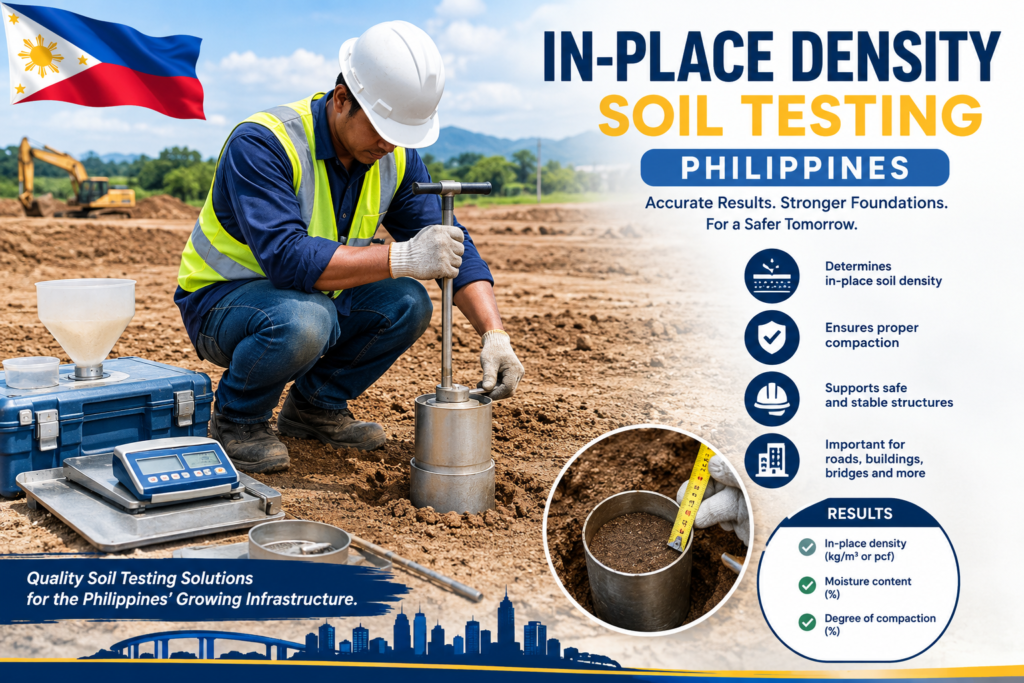
One commonly recognized approach is the sand-cone or sand-replacement method, which determines the volume of a field test hole using calibrated material. A representative portion of soil is removed from the selected test location and weighed, while the volume of the excavation is established using the testing apparatus. The resulting measurements can be used to determine the in-place wet density and, together with moisture-content information, the dry density of the soil. ASTM also publishes methods covering density of soil and rock in place using sand replacement in a test pit. DPWH documentation identifies AASHTO T 191 as a Field Density Test method for several soil and aggregate applications. Another approach used in some projects is nuclear density testing, which can provide rapid field measurements when the equipment, personnel, regulatory requirements, and project specifications support its use. The appropriate method should always be selected according to the project requirements, material characteristics, applicable standards, and qualified testing procedures.
How an In-Place Density Test Is Performed
The testing process begins with selecting a suitable location that represents the compacted layer being evaluated. The technician identifies the test point and records information such as the project location, layer, station, depth, or other identifying details required by the testing documentation. For a sand-replacement procedure, a controlled excavation is made in the compacted material and the recovered soil is collected for measurement and moisture determination. The volume of the excavation is then established using the appropriate calibrated equipment and testing procedure. The mass of the recovered soil and the measured test-hole volume are used to calculate field density, while moisture information allows the dry density to be determined. A current DPWH field density worksheet for AASHTO T191 includes information such as test-hole depth, location, layer information, air-dry sand unit weight, and actual moisture content. The resulting data are documented and evaluated against the applicable laboratory reference and project specification.
Laboratory Compaction Testing and Field Density Results
Laboratory compaction testing provides an important benchmark for evaluating compacted soil in the field. A laboratory test can establish how dry unit weight changes as moisture content changes under a specified compactive effort. ASTM D698 uses standard compactive effort, while ASTM D1557 uses a higher modified compactive effort. The selected laboratory procedure matters because different compactive efforts can produce different maximum dry unit weights and optimum moisture conditions. DPWH testing guidance also identifies laboratory compaction and Field Density Testing among the quality tests used for specified soil and aggregate applications. Field density measurements can therefore be compared with the appropriate laboratory value to calculate a percentage of compaction when required by the project. This relationship gives engineers and quality-control personnel a practical basis for evaluating whether field compaction work is achieving the specified performance target.
Applications of In-Place Density Soil Testing in the Philippines
In-place density soil Philippines testing can be relevant to many types of construction and infrastructure work. Road projects may require evaluation of compacted subgrade, embankment, aggregate layers, or other prepared materials according to the governing specifications. Building projects may use density testing for compacted fills and prepared areas where ground performance is important to the planned construction. Backfilling around structures, trenches, utilities, and other excavated areas can also require controlled placement and compaction. Large infrastructure projects may involve numerous compacted layers, making systematic field testing valuable for quality control throughout the earthwork process. DPWH quality-testing references list field density testing for several categories of soil, soil aggregates, subbase materials, and base-course materials. Because testing requirements vary according to the material and type of work, project teams should always use the applicable specifications rather than relying on a single universal testing rule.
Factors That Can Affect Field Density Results
Many variables can influence an in-place density measurement, beginning with the type and condition of the soil being tested. Moisture content can affect how easily soil particles rearrange during compaction and may influence the measured dry density. The thickness of each compacted lift can also matter because equipment may not provide uniform compactive influence throughout an excessively thick layer. The type of compaction equipment, number of passes, operating procedure, and site conditions can further affect the resulting density. Rainfall and changing site moisture conditions may also influence field work, particularly when earth materials are exposed before or during construction. Test location, sample handling, equipment condition, calibration, and calculation accuracy can influence the reliability of reported results. For this reason, a good In-place density soil Philippines testing program depends not only on taking measurements but also on controlling and documenting the conditions surrounding each measurement.
Understanding an In-Place Density Test Report
A field density report normally contains information that allows the test to be connected to a specific construction location and material layer. This may include the project name, testing date, test location, layer number, test depth, measured moisture content, field density, dry density, and relevant laboratory reference values. The report may also identify the testing method and standard used to perform the measurement. Percentage compaction can be calculated by comparing the measured field dry density with the applicable maximum dry density from laboratory testing. The resulting percentage should not automatically be treated as a pass or fail value because the required acceptance level depends on the project specification. ASTM guidance explains that laboratory compaction testing can provide the basis for determining percent compaction and water-content requirements for construction control. Accurate records are therefore important because engineers and project managers need enough information to interpret the field result correctly.
What Happens When Soil Does Not Meet the Required Density?
A field density result below the specified requirement should prompt an appropriate technical review rather than an immediate assumption that the entire project area is unsuitable. The first step may involve checking the test data, test location, material condition, moisture content, and applicable specification. Low density can result from insufficient compactive effort, excessive lift thickness, unsuitable moisture conditions, inconsistent material, or other construction factors. Depending on the project requirements, the affected area may need additional moisture conditioning, further compaction, removal and replacement, or another corrective procedure. Once corrective work has been performed, additional field testing may be required to verify the revised condition. Engineers and quality-control personnel should determine the appropriate response based on the project documents and technical requirements. Promptly addressing low-density results can help prevent additional construction work from covering a layer that has not yet been verified.
Selecting an In-Place Density Soil Testing Provider
Choosing an appropriate testing provider is an important consideration for projects that require reliable field density measurements. A qualified provider should understand the applicable test method and have appropriate equipment maintained for accurate field measurements. Project teams should ask which standard or procedure will be followed and whether the resulting documentation will clearly identify the tested location and material. It is also useful to verify that technicians understand field sampling, moisture determination, density calculations, and documentation requirements. Experience with similar construction environments can be valuable because different materials and site conditions may present different testing challenges. Testing should also be coordinated with the project’s engineer, contractor, and quality-control personnel so that the correct layers are tested at the appropriate stages. For projects using In-place density soil Philippines services, clear communication before testing can help ensure that the field work and reporting align with the project’s technical requirements.
Cost and Testing Frequency Considerations
The cost of field density testing can vary from one project to another. Factors may include the number of test points, project location, accessibility, testing method, required turnaround time, reporting requirements, and the total amount of earthwork involved. Larger projects may require multiple tests across different areas and construction layers rather than a single measurement. Testing frequency should be determined by the applicable specifications and the nature of the work rather than simply choosing the least expensive option. DPWH quality-assurance materials provide specific testing requirements for certain construction materials and work items, demonstrating that testing provisions can vary according to the application. Project teams should therefore review their technical documents before scheduling field testing. Proper planning can reduce delays by ensuring that required laboratory information, test locations, access, and project personnel are available when the testing team arrives.
Practical Checklist Before Scheduling Field Density Testing
Before requesting In-place density soil Philippines testing, the project team should identify exactly which material layer needs to be evaluated. The team should also confirm the project specification and determine which field density method is required or permitted. Relevant laboratory compaction information should be available so that field results can be evaluated against the appropriate benchmark. The test area should be accessible and prepared according to the requirements of the selected procedure. Site personnel should provide accurate location information so each test result can be traced to the correct construction layer. It is also useful to clarify the expected report format, turnaround time, and procedures for additional testing if a result does not meet the specified requirement. Careful coordination before testing can make field density work more efficient and can help reduce interruptions to the construction schedule.
Frequently Asked Questions About In-Place Density Soil Testing
What is an in-place density soil test?
An in-place density soil test measures the density of soil directly at a construction site. It is commonly used to evaluate compacted soil and determine whether field work meets specified requirements. The test can provide information about wet density, moisture content, and dry density depending on the procedure used. Field density results may be compared with laboratory compaction results to determine the degree of compaction. The appropriate comparison depends on the project specification and laboratory method. DPWH documents identify Field Density Testing as part of quality testing for several soil and aggregate applications. A qualified testing professional should interpret the result within the context of the applicable project requirements.
Why is field density testing important?
Field density testing helps verify that compacted soil has reached the required level specified for the project. Visual inspection alone cannot reliably determine the actual density of a compacted soil layer. Testing provides measurable information that can be documented and reviewed by the project team. It can help identify areas that may require additional compaction before subsequent work proceeds. Proper density control can also support more predictable performance of engineered fills and prepared construction surfaces. Laboratory compaction standards recognize the role of compaction in achieving desired engineering properties for fills, foundation pads, and road bases.
What is the difference between soil compaction and density testing?
Soil compaction is the construction activity used to densify soil, while density testing is the measurement used to evaluate the resulting field condition. Compaction equipment applies energy to soil and changes the arrangement of its particles. Density testing measures the resulting mass and volume characteristics at a selected location. Moisture content is also considered because dry density is often the key value used for comparison with laboratory compaction data. A project can therefore involve both a compaction operation and a separate testing operation. The testing does not replace proper compaction procedures performed by the contractor. Instead, it provides quality-control information about the condition achieved in the field.
What is the sand-cone test?
The sand-cone test is a field method that uses calibrated sand or another controlled material to determine the volume of an excavation made in the soil. Soil removed from the test area is weighed, and the volume of the test hole is determined using the calibrated apparatus. These measurements can be used to calculate the in-place density of the material. Moisture testing can then be used to determine dry density. DPWH references AASHTO T 191 for Field Density Testing in several construction applications. The method must be performed carefully because errors in excavation, collection, calibration, or measurement can affect the final result.
What does maximum dry density mean?
Maximum dry density is the highest dry unit weight obtained under the specified conditions of a laboratory compaction procedure. It is associated with a particular compactive effort and moisture-density relationship. The corresponding moisture condition is commonly referred to as optimum moisture content. ASTM D698 and ASTM D1557 are examples of laboratory methods used to establish compaction characteristics under different compactive efforts. The applicable laboratory method should match the requirements established by the project documents. Field density results can then be evaluated against the appropriate laboratory reference.
How often should soil density testing be performed?
There is no single testing frequency that applies to every construction project. The required frequency can depend on the type of material, work item, project specification, location, and governing standard. Some DPWH quality-assurance requirements specify testing frequencies for particular construction applications. Large earthwork projects may require testing at multiple locations and layers to provide adequate quality control. The responsible engineer or project specification should establish the applicable testing requirements. Testing providers should receive this information before field work begins so the correct scope can be followed.
What happens if a density test does not meet the project requirement?
A low result generally requires investigation and an appropriate corrective response based on the project requirements. The team may review moisture content, compaction effort, layer thickness, material characteristics, and the test procedure. Additional compaction may be required if the material can be brought to the specified condition through further work. In some situations, unsuitable material may require other corrective measures. Retesting can verify whether corrective work has produced the required result. The responsible engineer and project quality-control team should determine the appropriate action. Keeping detailed records of the original and subsequent tests helps maintain clear construction documentation.
Takeaway
In-place density soil Philippines testing provides valuable field information about the condition of compacted soil during construction. It connects laboratory compaction data with actual conditions at the project site and can help engineers and contractors verify that earthwork is being performed according to applicable requirements. Methods such as sand replacement are recognized in established testing procedures, while other field methods may be appropriate depending on the project. Moisture content, material type, compaction equipment, lift thickness, testing technique, and project specifications can all influence the results. Reliable testing requires appropriate procedures, competent personnel, suitable equipment, accurate documentation, and proper interpretation. Whether the project involves roads, embankments, building pads, backfill, or other engineered earthwork, field density testing can provide important quality-control information before construction progresses to later stages. For the best results, project teams should coordinate laboratory testing, field compaction, density measurements, and engineering requirements as part of one organized construction quality-control process.