








Construction projects require solid foundations to ensure structural safety and longevity. A Standard Penetration Test (SPT) provides critical insights into subsurface soil conditions, enabling engineers and builders to make informed decisions for foundation design. Understanding the properties of soil beneath a project site prevents costly errors, reduces risks, and supports safe construction practices. Inch-On Materials Testing Laboratory offers professional SPT services that combine field testing and laboratory analysis to guarantee accurate results and reliable assessments for every project.
What is a Standard Penetration Test?
A Standard Penetration Test is a widely used geotechnical investigation method that evaluates soil density, consistency, and mechanical properties. The test measures the resistance of soil to penetration by a standard sampler driven into the ground using a hammer of fixed weight. The number of blows required to advance the sampler a certain distance, commonly called the N-value, indicates the relative density of granular soils or the consistency of cohesive soils.
The Standard Penetration Test plays a critical role in foundation design. Soil behavior varies across locations, and factors such as compaction, moisture content, and composition directly impact the stability of a building. Engineers rely on SPT results to determine safe bearing capacity, select foundation types, and identify potential challenges such as soft layers or loose soil zones. Projects built without proper soil investigation risk settlement, structural damage, or failure, making SPT an essential part of geotechnical engineering.
The Standard Penetration Test Procedure
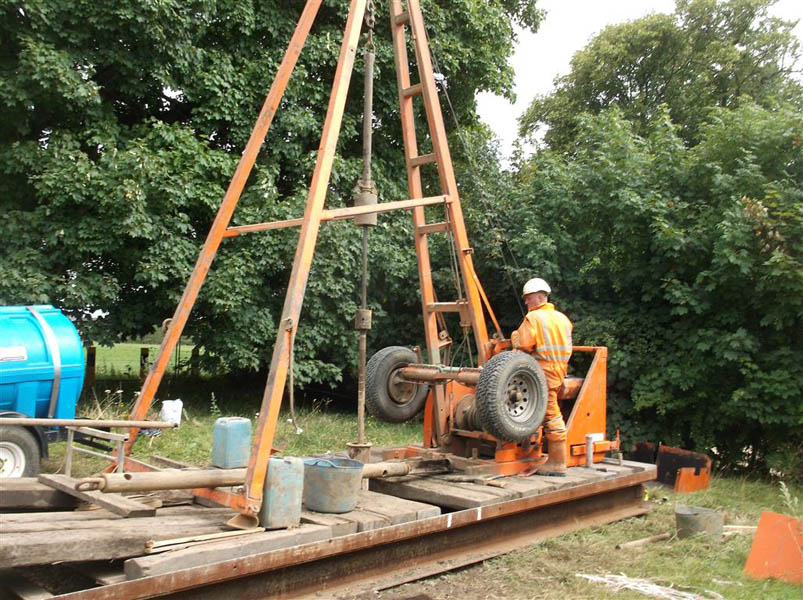
Conducting a Standard Penetration Test requires precise methodology and specialized equipment. The process begins with drilling a borehole to the target depth using an auger or rotary rig. A split-barrel sampler is then lowered into the borehole, and a standard hammer weighing 63.5 kg (140 lbs) is repeatedly dropped from a height of 76 cm (30 inches) to drive the sampler into the soil. The number of blows required to penetrate each 15 cm (6-inch) increment is recorded, with the sum of the second and third increments forming the N-value.
Field engineers also observe soil characteristics such as color, moisture, and texture during testing. The sampler and extracted soil samples are brought to the laboratory for further analysis. Laboratory tests can include moisture content, grain size distribution, Atterberg limits, and compaction tests. Combining field data from the Standard Penetration Test with laboratory results provides a comprehensive understanding of soil conditions and supports accurate foundation design.
Importance of Standard Penetration Test for Construction Projects
The Standard Penetration Test offers essential information that directly impacts construction safety and efficiency. Accurate N-values allow engineers to assess soil strength, estimate settlement, and determine the most suitable foundation type. Projects built on weak or loose soils without proper evaluation may experience uneven settlement, cracks, or even structural failure.
SPT results help engineers design foundations that align with soil properties. For example, a site with dense sand may support shallow foundations, while soft clay layers may require deep pile foundations. Understanding soil behavior also informs decisions on excavation, grading, and compaction. By identifying potential risks before construction begins, a Standard Penetration Test reduces project delays, minimizes repair costs, and enhances overall structural integrity.
How Inch-On Materials Testing Laboratory Conducts Standard Penetration Tests
Inch-On Materials Testing Laboratory provides professional Standard Penetration Test services across the Philippines, combining field expertise with advanced laboratory analysis. The laboratory is accredited by the Department of Public Works and Highways – Bureau of Research and Standards (DPWH-BRS) and follows ASTM and AASHTO standards for geotechnical testing.
Field engineers conduct on-site Standard Penetration Tests using specialized drilling rigs and samplers. Detailed records of blow counts, soil appearance, and sampling depth are maintained for each test location. Samples are then analyzed in the laboratory to determine soil properties, including moisture content, particle size distribution, and compaction characteristics. Results are compiled into a comprehensive geotechnical report, providing clear guidance for foundation design and construction planning.
Clients benefit from Inch-On’s combination of reliable field testing, accurate laboratory evaluation, and professional reporting, ensuring that each Standard Penetration Test delivers actionable insights. The laboratory’s team has extensive experience with various soil types, including clay, silt, sand, and gravel, and can adapt testing procedures to suit complex site conditions.
Benefits of Standard Penetration Test Services
A Standard Penetration Test offers multiple benefits for construction projects, starting with precise knowledge of subsurface conditions. This knowledge supports safe foundation design, reduces the likelihood of structural problems, and helps avoid unnecessary over-engineering.
By providing clear data on soil density and consistency, the Standard Penetration Test allows engineers to select appropriate foundation systems, whether shallow footings, mat foundations, or deep piles. It also informs site preparation techniques, including compaction and stabilization measures. Accurate soil assessment can save time and money, preventing unexpected excavation issues or soil failures during construction.
Standard Penetration Test results also support compliance with regulatory requirements. Many local building codes and engineering standards require geotechnical investigation, making professional SPT services essential for project approval and certification. Clients gain confidence knowing that foundation design decisions are based on verified soil data rather than assumptions or visual inspection alone.
Applications of Standard Penetration Test
The Standard Penetration Test has wide-ranging applications across construction and civil engineering projects. It is particularly useful for:
- Residential, commercial, and industrial building foundations
- Road, bridge, and highway construction projects
- Retaining walls, embankments, and slope stabilization
- Soil improvement and ground reinforcement evaluation
SPT data can also support advanced geotechnical modeling, such as settlement analysis, liquefaction assessment, and slope stability calculations. By providing a reliable measure of soil resistance, Standard Penetration Test results form the basis for safe design, long-term performance, and structural resilience.
Factors That Affect Standard Penetration Test Results
Several factors influence the outcomes of a Standard Penetration Test, including soil type, moisture content, and test procedure. Cohesive soils such as clay may exhibit varying N-values depending on moisture levels, while granular soils like sand and gravel provide more consistent resistance measurements. Depth of testing, borehole diameter, and hammer efficiency can also affect blow counts.
Experienced engineers at Inch-On Materials Testing Laboratory account for these factors, ensuring accurate interpretation of results. Combining SPT data with laboratory soil analysis reduces uncertainty and provides a clear understanding of site conditions. This approach ensures that foundation designs are based on reliable data, minimizing risks associated with variable soil properties.
Why Choose Inch-On Materials Testing Laboratory for Standard Penetration Test
Choosing a trusted provider for Standard Penetration Test services is critical for construction success. Inch-On Materials Testing Laboratory offers:
- DPWH-BRS accreditation and compliance with international standards
- Experienced engineers trained in geotechnical investigation
- Advanced field and laboratory equipment for precise testing
- Detailed geotechnical reports with actionable recommendations
The laboratory’s integrated approach ensures that both field data and laboratory results inform foundation design decisions. Clients benefit from accurate, reliable, and professionally presented information that supports safe, cost-effective construction projects.
Takeaway
Standard Penetration Test services provide essential insights for construction projects, enabling engineers to design foundations with confidence and avoid costly mistakes. Inch-On Materials Testing Laboratory offers professional SPT services with precise field testing, advanced laboratory analysis, and comprehensive reporting. Accurate soil assessment ensures safe, reliable, and durable structures that comply with industry standards and regulatory requirements.
Frequently Asked Questions About Standard Penetration Test
What is the purpose of a Standard Penetration Test?
The test measures soil density and consistency to provide critical data for foundation design and construction planning.
How long does a Standard Penetration Test take?
Test duration varies depending on site conditions, depth, and number of boreholes, but most tests can be completed within a day for a single site location.
Can Standard Penetration Test be performed on all soil types?
SPT is suitable for most granular and cohesive soils, though highly soft soils or extremely dense rock may require modified procedures or alternative testing methods.
How are N-values used in construction?
N-values indicate soil resistance to penetration and help engineers determine safe bearing capacity, foundation type, and potential settlement.
Why choose Inch-On Materials Testing Laboratory for SPT?
Inch-On combines field expertise, advanced laboratory testing, and DPWH-BRS accreditation to provide accurate, reliable, and actionable soil investigation results for construction projects across the Philippines.
Do Standard Penetration Test results include recommendations?
Yes, results are compiled into detailed geotechnical reports with recommendations for foundation design, soil stabilization, and construction planning.
Is Standard Penetration Test required by building codes?
Many local regulations and engineering standards require geotechnical investigations, including SPT, to ensure safe and compliant construction practices.