





Construction projects rely heavily on the stability and reliability of the soil beneath a structure. Geotechnical Soil Investigation plays a crucial role in determining soil conditions and providing engineers with the data needed to design safe and durable foundations. Without proper soil analysis, structures are vulnerable to settlement, cracking, or even collapse. Understanding soil behavior before construction begins can save significant costs and prevent serious safety issues.
Geotechnical Soil Investigation examines soil properties such as density, consistency, and load-bearing capacity. These evaluations help engineers design foundations suited to site conditions and environmental factors. Inch-On Materials Testing Laboratory offers comprehensive services to ensure that every construction project in the Philippines begins on a solid foundation.
What is Geotechnical Soil Investigation?
Geotechnical Soil Investigation is the systematic process of studying soil and subsoil properties to assess suitability for construction. The investigation identifies soil layers, moisture content, compaction, strength, and other characteristics that influence foundation performance.
By evaluating soil behavior, engineers can determine the type of foundation required, whether shallow or deep, and prevent structural problems caused by weak or uneven soil. Geotechnical Soil Investigation provides crucial information for designing building foundations, roadways, bridges, and other infrastructure projects. Accurate soil analysis also ensures compliance with safety standards, reducing the risk of structural failures and costly repairs.
Standard Penetration Test (SPT) Explained
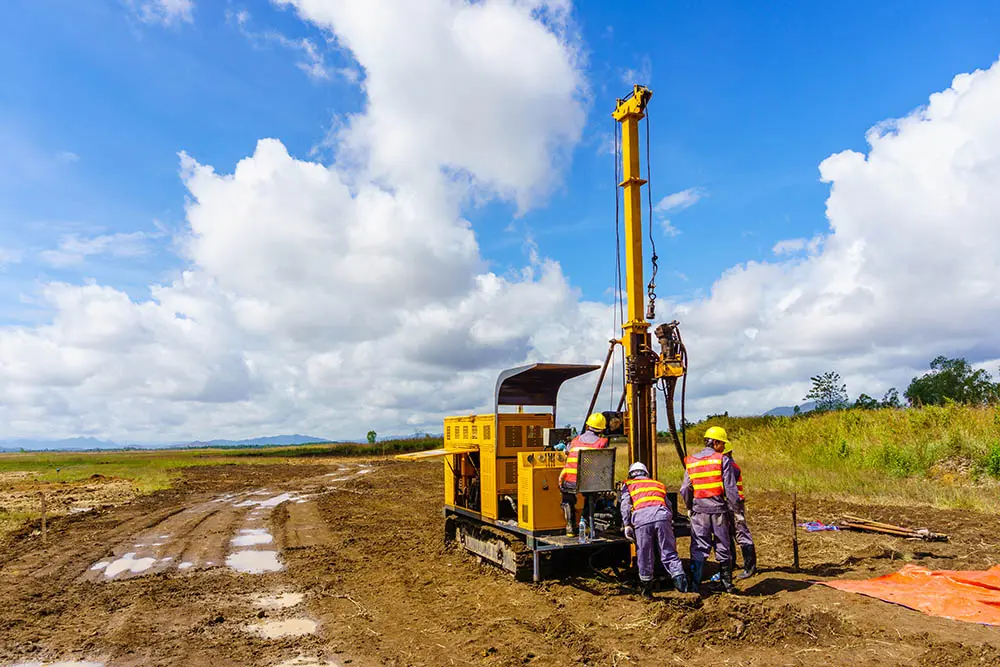
The Standard Penetration Test (SPT) is one of the most widely used procedures in Geotechnical Soil Investigation. This test measures soil density and resistance to penetration, which are essential for evaluating load-bearing capacity. SPT involves driving a split-barrel sampler into the soil at the bottom of a borehole using a standardized hammer and recording the number of blows required to penetrate a set distance.
SPT results, commonly expressed as N-values, provide a reliable indication of soil consistency and strength. These values help engineers classify soil layers, assess settlement potential, and determine appropriate foundation design. The SPT is particularly useful for projects in areas with variable soil conditions, making it an indispensable tool in Geotechnical Soil Investigation.
Field Testing Services by Inch-On
Field testing forms a critical component of Geotechnical Soil Investigation. These on-site tests evaluate soil, concrete, and pile foundations directly at the construction site. By conducting tests in situ, engineers gain accurate insights into the soil’s behavior under real-world conditions.
Inch-On Materials Testing Laboratory provides a comprehensive range of field testing services. Soil tests assess density, moisture content, and compaction, while concrete and pile testing ensure foundation materials meet strength and stability requirements. Field testing follows internationally recognized procedures, delivering precise data that supports safe and reliable construction.
Field testing during Geotechnical Soil Investigation allows construction teams to identify potential issues early, preventing project delays and reducing the risk of structural failures. By measuring actual soil performance, these tests complement laboratory analysis to provide a complete understanding of site conditions.
Laboratory Testing Services
Laboratory testing enhances Geotechnical Soil Investigation by offering controlled analysis of soil and construction materials. Inch-On’s laboratory services focus on precise evaluation, quality verification, and compliance with ASTM and AASHTO standards.
Laboratory testing examines soil composition, particle size, moisture content, and compaction properties. It also evaluates concrete and foundation materials for strength, durability, and conformity with engineering specifications. The data obtained in the laboratory ensures that materials used in construction meet project requirements, reducing the risk of foundation settlement or failure.
By integrating laboratory testing with field results, Geotechnical Soil Investigation provides a complete profile of soil conditions. This combination allows engineers to design foundations optimized for stability, safety, and long-term performance.
Why Geotechnical Soil Investigation Matters
Geotechnical Soil Investigation is vital for construction safety, project efficiency, and regulatory compliance. Soil conditions directly impact foundation design and structural integrity. Without proper investigation, structures may experience uneven settlement, cracking, or even collapse.
Accurate soil analysis helps prevent costly redesigns, foundation failures, and delays during construction. It ensures that foundations are tailored to the site’s specific soil characteristics, improving stability and durability. Geotechnical Soil Investigation also ensures compliance with Philippine building codes and DPWH-BRS standards, protecting both contractors and project owners from legal or safety liabilities.
Beyond safety, Geotechnical Soil Investigation contributes to cost efficiency. By identifying potential soil issues early, construction teams can implement appropriate mitigation measures, select suitable foundation types, and avoid overdesigning structures. This proactive approach reduces construction costs and prevents future maintenance expenses.
Choosing the Right Testing Laboratory
Selecting a reliable laboratory is essential for accurate Geotechnical Soil Investigation. Inch-On Materials Testing Laboratory offers expertise, experience, and advanced equipment to deliver dependable results. Accredited by DPWH-BRS, Inch-On follows strict testing protocols and international standards to ensure the highest quality.
The laboratory employs skilled engineers and technicians trained in soil, concrete, and foundation testing. Field testing teams provide on-site assessments, while laboratory specialists perform precise analysis of soil and construction materials. By combining these services, Inch-On delivers a complete Geotechnical Soil Investigation that supports safe, efficient, and compliant construction projects.
Working with an accredited and experienced laboratory ensures that engineers receive trustworthy data for designing foundations that meet structural and safety requirements. Inch-On’s commitment to quality, accuracy, and compliance makes it a top choice for construction professionals seeking reliable Geotechnical Soil Investigation services in the Philippines.
Applications of Geotechnical Soil Investigation
Geotechnical Soil Investigation is applicable across various construction projects. It is used in building residential, commercial, and industrial structures, as well as infrastructure projects like roads, bridges, and water management systems.
For buildings, soil investigation guides foundation type selection, load distribution, and structural reinforcement. For infrastructure projects, it ensures that soil and subsoil conditions can safely support heavy loads, reducing the risk of failure. Geotechnical Soil Investigation also helps with environmental assessments, determining the potential impact of construction on surrounding areas and groundwater conditions.
By providing accurate soil information, Geotechnical Soil Investigation enables engineers to design safe, efficient, and durable structures tailored to site-specific conditions. It remains a critical step in every construction project, regardless of size or complexity.
Steps Involved in Geotechnical Soil Investigation
Geotechnical Soil Investigation typically involves several stages to ensure thorough analysis:
Site Assessment: Engineers conduct a preliminary evaluation of the site, reviewing maps, geological reports, and environmental data to identify potential soil issues.
Borehole Drilling: Boreholes are drilled to collect soil samples at various depths for analysis.
Standard Penetration Test (SPT): Conducted at each borehole, SPT provides N-values to determine soil density and consistency.
Laboratory Analysis: Soil samples undergo detailed testing in the laboratory to assess composition, compaction, moisture content, and strength.
Data Interpretation and Reporting: Engineers compile field and laboratory results, providing recommendations for foundation design and construction planning.
These steps ensure that Geotechnical Soil Investigation delivers a comprehensive understanding of site conditions, supporting safe and effective foundation design.
Takeaway
Geotechnical Soil Investigation is an essential step for safe, durable, and efficient construction. By providing accurate information on soil density, composition, and behavior, it enables engineers to design foundations suited to each site. Inch-On Materials Testing Laboratory offers comprehensive field and laboratory services, combining expertise, advanced equipment, and DPWH-BRS accreditation to deliver reliable results.
Engaging a professional laboratory for Geotechnical Soil Investigation ensures project safety, compliance, and long-term structural integrity. Contact Inch-On to schedule a consultation and ensure that your construction project rests on a solid foundation.
Frequently Asked Questions (FAQ)
What is the purpose of Geotechnical Soil Investigation?
Geotechnical Soil Investigation identifies soil properties and behavior to support safe and reliable foundation design. It helps prevent structural failures and ensures compliance with safety standards.
What is the Standard Penetration Test (SPT)?
The SPT measures soil resistance to penetration using a split-barrel sampler and standardized hammer. It provides N-values used to classify soil layers and assess foundation suitability.
How long does Geotechnical Soil Investigation take?
The duration depends on project size, site conditions, and number of boreholes. Typically, field testing and laboratory analysis may take several days to a few weeks.
Why choose a DPWH-BRS accredited laboratory?
Accredited laboratories follow strict protocols and standards, providing reliable results that comply with Philippine regulations and international best practices.
Can Geotechnical Soil Investigation prevent foundation problems?
Yes. By identifying soil weaknesses, engineers can design foundations that account for potential settlement, compaction, or load-bearing issues.
What types of construction require Geotechnical Soil Investigation?
All major construction projects, including residential, commercial, industrial, and infrastructure projects, benefit from soil investigation to ensure stability and safety.