








Soil Testing plays a critical role in every construction project because the ground beneath a structure determines its stability, safety, and lifespan. Without proper Soil Testing, engineers cannot accurately assess whether the site can support planned loads or how it will behave over time under stress.
Soil Testing helps identify key engineering properties such as bearing capacity, compressibility, moisture response, and density. These factors directly influence whether a building will remain stable or experience settlement issues after construction.
When Soil Testing is overlooked or done poorly, construction projects face serious risks. Uneven settlement may cause cracks in walls and foundations, while weak soil layers may lead to structural failure. Soil Testing reduces these risks by giving engineers reliable data before construction begins.
Soil Testing also helps contractors make informed decisions about foundation design. Whether the project involves roads, bridges, or buildings, Soil Testing ensures that design choices match actual ground conditions rather than assumptions.
Overview of Professional Soil Testing Services
Professional Soil Testing combines both field and laboratory methods to create a complete understanding of ground conditions. Each Soil Testing method contributes unique information that supports safe engineering design.
Field Soil Testing focuses on on-site conditions. It measures how soil behaves under natural conditions and construction activity. Laboratory Soil Testing focuses on controlled analysis of soil samples to determine classification, strength, and composition.
A combined Soil Testing approach produces more accurate results. Field Soil Testing identifies real-time soil behavior, while laboratory Soil Testing confirms material properties under standardized conditions.
At Inch-On Materials Testing Laboratory, Soil Testing services follow recognized engineering standards to support safe and reliable construction outcomes.
ASTM and DPWH-BRS Standards for Reliable Soil Testing
Soil Testing must follow strict standards to ensure accuracy and consistency. ASTM and AASHTO guidelines define how Soil Testing should be performed and interpreted.
ASTM D1586 guides the Standard Penetration Test used in Soil Testing to measure resistance and density. ASTM D4318 defines procedures for Atterberg Limits, which determine soil plasticity and behavior when exposed to moisture. ASTM D422 focuses on particle size distribution, a key Soil Testing method for soil classification.
DPWH-BRS accreditation also plays an important role in Soil Testing within infrastructure projects. This accreditation ensures that Soil Testing results meet national construction requirements and engineering expectations.
Following these standards ensures Soil Testing results remain consistent, reliable, and suitable for structural design decisions.
Field Soil Testing Methods Used in Construction Projects
Field Soil Testing evaluates soil directly at the construction site. This type of Soil Testing provides immediate insight into real ground conditions.
Standard Penetration Test (SPT)
The Standard Penetration Test is a widely used Soil Testing method that measures soil resistance. It helps engineers understand soil density and strength at different depths.
Plate Load Test
Plate Load Soil Testing evaluates how soil responds to applied loads. This method helps determine bearing capacity, which is essential for foundation design.
Field Density and DCPT Testing
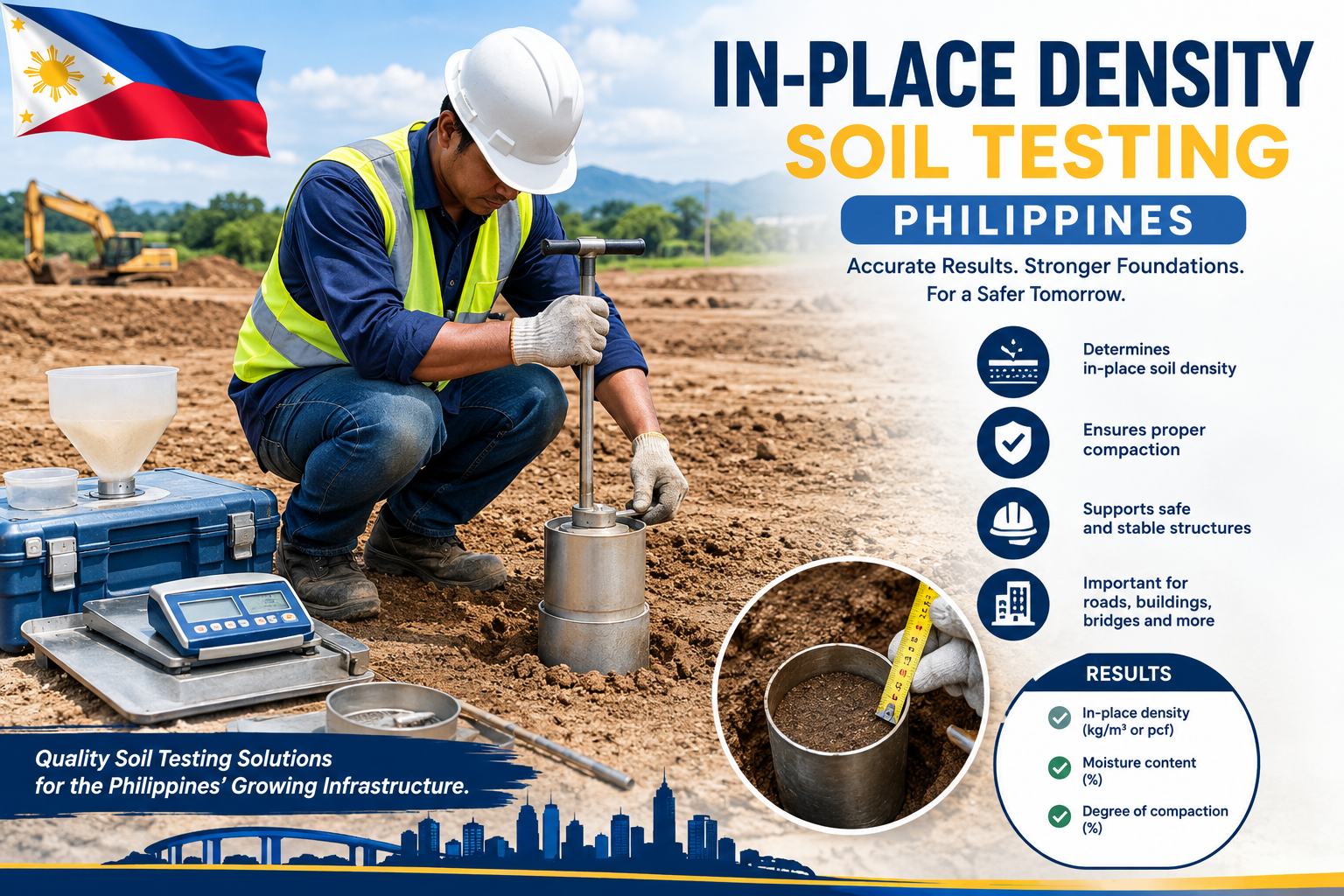
Field Density Soil Testing measures compaction levels, while DCPT Soil Testing evaluates soil strength using penetration resistance. Both methods support road and structural foundation planning.
Pile Integrity Testing
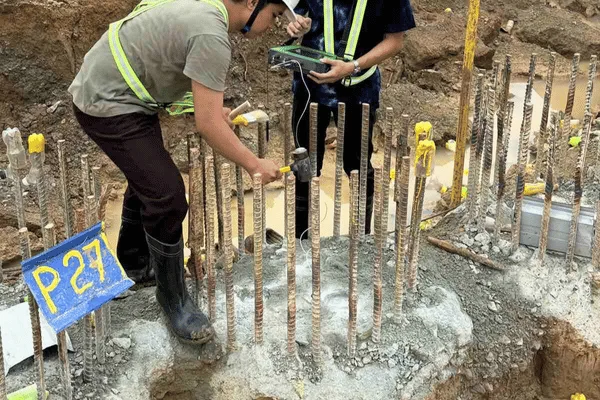
Pile Integrity Soil Testing checks the stability of deep foundations. It ensures piles can safely transfer structural loads to deeper soil layers.
Laboratory Soil Testing Procedures
Laboratory Soil Testing provides controlled analysis of soil samples collected from the site. This type of Soil Testing produces precise measurements that support engineering design.
Grain Size Analysis
Grain Size Soil Testing identifies the distribution of sand, silt, and clay. This classification helps engineers understand drainage and stability behavior.
Atterberg Limits Test
Atterberg Limits Soil Testing evaluates soil plasticity and moisture sensitivity. It shows how soil changes from solid to plastic and liquid states.
Moisture Content Determination
Moisture Content Soil Testing measures water presence in soil. High moisture levels may reduce soil strength and increase settlement risks.
Compaction and CBR Testing
Compaction Soil Testing and California Bearing Ratio Soil Testing assess soil suitability for roads and foundations. These tests measure strength and load-bearing performance.
From Data to Decision: How Soil Testing Results Guide Engineering Design
Soil Testing results guide engineers in selecting the right foundation type and construction method. Each Soil Testing report provides data that helps evaluate soil strength, stability, and behavior under load.
Engineers use Soil Testing results to design shallow or deep foundations depending on soil conditions. Soil Testing also helps identify weak layers that require soil improvement or stabilization.
Soil Testing data supports risk reduction by identifying potential settlement zones before construction begins. This allows project teams to adjust designs early, reducing delays and unexpected costs.
Clear interpretation of Soil Testing results ensures that construction decisions align with actual ground conditions rather than assumptions.
Equipment and Accuracy in Soil Testing
Accurate Soil Testing depends on well-calibrated equipment and controlled procedures. High-quality Soil Testing instruments measure particle size, density, moisture, and plasticity with precision.
Soil Testing equipment must be regularly checked to ensure consistent performance. Any variation in measurement can affect engineering conclusions.
Reliable Soil Testing also depends on proper sample handling. Soil samples must be collected, stored, and processed carefully to preserve natural properties.
Accurate Soil Testing supports safe design decisions and long-term structural performance.
Field vs Laboratory Soil Testing: Key Differences
Field Soil Testing and laboratory Soil Testing serve different but complementary purposes.
Field Soil Testing evaluates soil conditions directly at the construction site. It provides real-time data about strength and behavior under natural conditions.
Laboratory Soil Testing examines soil samples under controlled environments. It provides detailed measurements of composition, classification, and physical properties.
Field Soil Testing shows how soil behaves under actual conditions, while laboratory Soil Testing confirms its technical properties. Combining both Soil Testing methods results in a complete soil profile for engineering design.
Why Choose a DPWH-BRS Accredited Testing Laboratory
Choosing a DPWH-BRS accredited laboratory for Soil Testing ensures that results meet government construction standards. Accredited Soil Testing services provide reliable data for infrastructure and building projects.
Accredited Soil Testing also reduces project risks by ensuring consistency and accuracy in test results. Engineers and contractors can rely on Soil Testing data for safe decision-making.
Professional Soil Testing laboratories follow strict procedures that maintain quality and reliability across all tests.
Industries That Rely on Soil Testing
Soil Testing supports a wide range of industries involved in construction and infrastructure development.
Road and highway projects depend on Soil Testing to ensure pavement stability. Building construction relies on Soil Testing for foundation design. Bridge projects require Soil Testing to evaluate deep soil layers and load-bearing capacity.
Industrial developments also depend on Soil Testing to ensure long-term structural safety. Every major construction sector depends on accurate Soil Testing data.
Step-by-Step Soil Testing Process
The Soil Testing process follows a structured sequence to ensure accurate results.
Soil Testing begins with site inspection and sample collection. Field Soil Testing follows to evaluate ground conditions. Laboratory Soil Testing is then performed on collected samples.
After analysis, Soil Testing data is reviewed and interpreted. Engineers then use Soil Testing results to prepare recommendations for foundation design and construction planning.
Final Soil Testing reports provide detailed insights for project execution.
Benefits of Professional Soil Testing Services
Professional Soil Testing provides several important benefits for construction projects.
Soil Testing improves structural safety by identifying weak soil conditions early. It reduces construction costs by preventing design errors. Soil Testing also improves foundation design accuracy.
Long-term durability of structures depends on reliable Soil Testing results. Proper Soil Testing supports better engineering decisions and safer construction outcomes.
Frequently Asked Questions (FAQ)
What is Soil Testing in construction?
Soil Testing is the process of evaluating soil properties to determine its suitability for supporting structures.
Why is Soil Testing important before construction?
Soil Testing helps prevent structural failure by identifying weak or unstable soil conditions before construction begins.
What methods are used in Soil Testing?
Soil Testing methods include field tests like SPT and plate load tests, and laboratory tests such as grain size and Atterberg limits.
How long does Soil Testing take?
Soil Testing duration depends on project size, but most standard Soil Testing procedures take several days to complete.
What does a Soil Testing report include?
A Soil Testing report includes soil classification, strength data, moisture levels, and engineering recommendations.
Who needs Soil Testing services?
Soil Testing is required for builders, engineers, contractors, and developers involved in construction projects.