








Rebound Hammer Test plays a major role in modern construction quality assessment, especially when engineers need fast information about concrete condition without causing damage to structural members. Rebound Hammer Test gives a practical method for checking surface hardness and estimating concrete strength directly at the project site.
Rebound Hammer Test supports decision-making during construction, inspection, repair planning, and structural evaluation. It helps engineers identify whether concrete meets expected performance levels and whether further testing or corrective action is required. Rebound Hammer Test is widely used across building projects, bridges, roads, and industrial structures because it provides quick results with minimal preparation.
Rebound Hammer Test is commonly paired with other evaluation methods to give a more complete view of structural performance. This makes it an essential tool for quality assurance programs and safety inspections conducted by professional testing laboratories such as Inch-On Materials Testing Laboratory.
What Is Rebound Hammer Test
Rebound Hammer Test is a non-destructive testing method that estimates the surface hardness of hardened concrete using a spring-driven hammer mechanism. Rebound Hammer Test measures the rebound distance of a plunger after it strikes the concrete surface. The rebound value is then used to estimate compressive strength based on established correlation charts.
Rebound Hammer Test does not require core extraction or structural damage. Instead, it relies on surface response, making it suitable for quick field assessment. Engineers use Rebound Hammer Test to check consistency, identify weak areas, and monitor quality variations across concrete surfaces.
Rebound Hammer Test is often used during early strength verification, structural surveys, and maintenance inspections where time and structural integrity are important considerations.
Principle Behind Rebound Hammer Test
Rebound Hammer Test works through a simple mechanical principle involving impact energy and surface hardness response. A spring-loaded hammer is released onto the concrete surface. The plunger strikes the surface and rebounds based on the hardness of the material.
Rebound Hammer Test readings are recorded as a rebound number. Higher rebound values generally indicate harder and stronger concrete surfaces, while lower values suggest weaker or less dense material. These values are then interpreted using standardized correlation curves.
Rebound Hammer Test follows ASTM C805, which provides guidelines for proper execution, calibration, and interpretation. The standard ensures that Rebound Hammer Test results remain consistent and comparable across different projects and conditions.
Rebound Hammer Test results are influenced by factors such as surface condition, moisture content, carbonation, and aggregate distribution. Engineers consider these factors when analyzing data to ensure accurate interpretation.
Key Applications of Rebound Hammer Test
Rebound Hammer Test is widely applied across different stages of construction and maintenance. One of the most common uses of Rebound Hammer Test is quality control during concrete placement. Engineers use Rebound Hammer Test to verify whether newly cast elements meet expected strength requirements.
Rebound Hammer Test is also used for structural evaluation of slabs, beams, columns, and retaining walls. It helps identify variations in concrete quality within the same structure. This makes Rebound Hammer Test useful for detecting weak zones or inconsistent curing conditions.
Rebound Hammer Test is frequently used in assessment of aging structures. It helps engineers evaluate surface deterioration and determine whether repair or rehabilitation is necessary. Rebound Hammer Test supports maintenance planning by providing quick condition indicators.
Rebound Hammer Test is also useful before core drilling or cutting operations. It helps identify areas that may require further investigation before structural modification begins. This reduces the risk of damaging critical structural elements.
Rebound Hammer Test Procedure
Rebound Hammer Test follows a systematic field procedure to ensure accurate and repeatable results. The first step involves surface preparation. The test area must be clean, smooth, and free from loose particles or coatings that may affect readings.
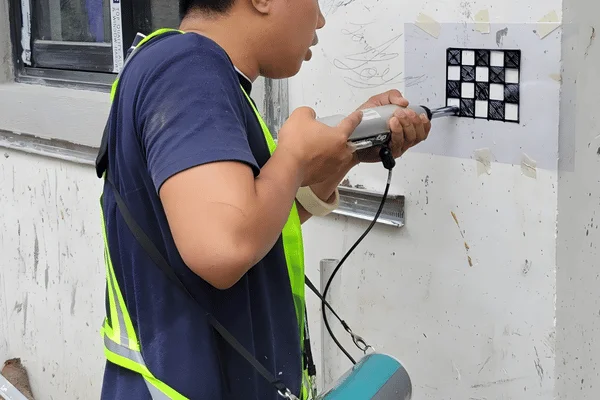
Rebound Hammer Test requires marking a grid on the surface to ensure consistent measurement points. Multiple readings are taken within the same area to improve reliability.
Rebound Hammer Test equipment is checked and calibrated before use. Proper calibration ensures that the hammer responds correctly during impact.
During Rebound Hammer Test, the device is pressed firmly against the surface until the hammer is released. The rebound value is recorded after each impact. This process is repeated across all marked points.
Rebound Hammer Test data is then reviewed, and abnormal readings are excluded. The remaining values are averaged to produce a representative result for the tested area.
Interpretation of Rebound Hammer Test Results
Rebound Hammer Test results are interpreted using rebound number correlations with compressive strength. Higher rebound numbers generally indicate higher surface hardness and stronger concrete. Lower values suggest reduced strength or surface deterioration.
Rebound Hammer Test interpretation must consider environmental and structural factors. Moisture, surface roughness, carbonation depth, and age of concrete can affect readings. Engineers adjust interpretation based on site conditions.
Rebound Hammer Test results are not final compressive strength values. They provide estimates that must be supported by additional testing when required. Core sampling or other non-destructive methods may be used to confirm findings.
Rebound Hammer Test is most reliable when used for comparative assessment across different areas of the same structure rather than absolute strength determination.
Advantages of Rebound Hammer Test
Rebound Hammer Test provides several advantages in construction evaluation. It is non-destructive, meaning no damage occurs to structural elements during testing. This makes Rebound Hammer Test suitable for finished structures and sensitive components.
Rebound Hammer Test delivers fast results, allowing engineers to make quick decisions on site. This is especially useful during active construction projects where time is critical.
Rebound Hammer Test is cost-effective compared to destructive testing methods. It reduces the need for extensive sampling and laboratory analysis.
Rebound Hammer Test can be performed on a wide range of structural elements, making it flexible for different project requirements.
Rebound Hammer Test also supports large-area assessment, helping engineers evaluate uniformity across entire structures.
Limitations of Rebound Hammer Test
Rebound Hammer Test has certain limitations that must be considered during interpretation. It only evaluates surface hardness and does not directly measure internal concrete strength.
Rebound Hammer Test results can be affected by surface conditions such as roughness, moisture, and carbonation. These factors may lead to variations in readings.
Rebound Hammer Test is less effective on deteriorated or highly irregular surfaces. Accurate results require proper surface preparation.
Rebound Hammer Test should not be used as the sole method for structural safety evaluation. It is best combined with other testing methods for a more complete assessment.
Rebound Hammer Test in Construction Projects
Rebound Hammer Test is widely used in construction projects for quality assurance and structural verification. During new construction, Rebound Hammer Test helps confirm that concrete elements meet design expectations.
Rebound Hammer Test is also used in infrastructure projects such as bridges, roads, and industrial facilities. It supports inspection programs that ensure long-term durability.
Rebound Hammer Test plays an important role in rehabilitation and retrofit projects. It helps engineers evaluate existing conditions before structural upgrades are performed.
Rebound Hammer Test is often combined with rebar scanning and other non-destructive methods to provide a complete understanding of structural performance.
Why Choose Inch-On Materials Testing Laboratory
Rebound Hammer Test services provided by a qualified laboratory ensure accuracy and reliability in results. Inch-On Materials Testing Laboratory offers professional Rebound Hammer Test services supported by trained personnel and calibrated equipment.
Rebound Hammer Test conducted by accredited laboratories follows ASTM C805 standards and recognized engineering practices. This ensures that results are suitable for engineering evaluation and compliance reporting.
Rebound Hammer Test services from accredited providers support decision-making in construction quality control, structural assessment, and maintenance planning. Field teams ensure proper execution and consistent data collection.
Related Non-Destructive Testing Services
Rebound Hammer Test is often paired with other evaluation methods for a more complete structural assessment. These include rebar scanning using ground penetrating radar, concrete cover measurement, and structural condition surveys.
Rebound Hammer Test combined with field testing and laboratory testing services provides a broader understanding of material performance. Soil testing and pile foundation evaluation also support overall construction quality assurance programs.
Takeaway
Rebound Hammer Test remains one of the most practical non-destructive testing methods for evaluating concrete quality and estimating strength. Rebound Hammer Test supports engineers in making informed decisions during construction, inspection, and maintenance activities.
Rebound Hammer Test provides fast, reliable, and cost-efficient insights into surface hardness and structural consistency. When performed by accredited laboratories such as Inch-On Materials Testing Laboratory, Rebound Hammer Test contributes to safer and more reliable construction outcomes across various project types.
Frequently Asked Questions about Rebound Hammer Test
What is Rebound Hammer Test used for?
Rebound Hammer Test is used to estimate concrete surface hardness and assess uniformity and quality of concrete structures.
Is Rebound Hammer Test destructive?
Rebound Hammer Test is non-destructive and does not damage concrete surfaces.
How accurate is Rebound Hammer Test?
Rebound Hammer Test provides estimated strength values and should be supported with additional testing when required.
What standard governs Rebound Hammer Test?
Rebound Hammer Test follows ASTM C805 guidelines for proper execution and interpretation.
Where can Rebound Hammer Test be applied?
Rebound Hammer Test can be applied to slabs, beams, columns, walls, and other hardened concrete surfaces.
Can Rebound Hammer Test replace core testing?
Rebound Hammer Test cannot fully replace core testing. It is mainly used for estimation and comparative assessment.