







Hidden cracks, voids, honeycombing, and other internal flaws can affect the strength, service life, and reliability of a structure. Visual checks may show surface damage, yet many serious problems remain below the surface. An Ultrasonic Test gives engineers, contractors, developers, and project owners a practical way to assess material condition without cutting, drilling, or breaking the tested component.
An Ultrasonic Test uses high-frequency sound waves to examine concrete, steel, welds, and other applicable materials. These sound waves travel through the test area and react whenever they meet a crack, gap, boundary, or irregular section. Trained technicians study these reactions and prepare technical findings that support quality control, repair planning, and project acceptance.
Inch-On Materials Testing Laboratory provides professional Ultrasonic Test services across the Philippines. Established during November 2018, the laboratory operates as an independent engineering and construction testing provider. It holds accreditation from the Department of Public Works and Highways–Bureau of Research and Standards and follows applicable ASTM and AASHTO procedures.
What Is an Ultrasonic Test?
An Ultrasonic Test is a non-destructive testing method that uses sound waves above the range of normal human hearing. A testing device sends these waves through a material. When the sound passes through a uniform section, the signal follows a predictable path. A hidden crack, void, inclusion, or material boundary may reflect or change that signal.
Technicians collect the response and compare readings from several test points. Changes related to travel time, signal strength, pulse velocity, or reflection pattern may show areas that need closer assessment. Test results can help determine whether a component appears consistent or whether possible defects require added checks.
The non-destructive nature of an Ultrasonic Test offers a major benefit. Most tested parts remain intact and usable after the procedure. Project teams can gather technical data while avoiding needless demolition, surface damage, or sample removal.
How an Ultrasonic Test Works
A typical Ultrasonic Test starts with project review. The testing team checks drawings, material details, suspected defect locations, access conditions, and client requirements. This helps define the test method, equipment, point spacing, and reporting format.
A transducer sends sound energy through the material. Depending on the selected procedure, another transducer may receive the signal from an opposite or nearby surface, or the same probe may collect reflected waves. A coupling material may be placed between the probe and test surface to support proper sound transfer.
Sound waves behave differently whenever they reach a discontinuity. A solid and consistent section usually allows steady transmission. A crack, air pocket, poorly compacted zone, or other irregularity can slow, scatter, weaken, or reflect the pulse.
The technician records each response and checks it against nearby readings, known material properties, calibration references, and project specifications. One unusual reading does not always prove that a major defect exists. Surface condition, moisture, reinforcement, thickness, temperature, and component shape may also affect results. Careful interpretation remains necessary.
Why Hidden Defects Matter
Structural defects do not always appear through visible signs. A beam may look acceptable from the outside while containing a void. A concrete wall may show only a minor surface mark despite deeper cracking. A pile may have a questionable section that cannot be viewed after casting.
Undetected flaws may cause reduced durability, uneven load transfer, water entry, corrosion risk, repeated repairs, or early material failure. They may also create disputes between owners, contractors, suppliers, and consultants. Project delays can follow when teams lack reliable information about actual material condition.
An Ultrasonic Test helps project teams locate areas that deserve added review. Early detection can reduce the amount of repair work, limit unnecessary removal, and support more focused engineering decisions. Test data may also help document quality checks before turnover or acceptance.
Defects an Ultrasonic Test May Detect
An Ultrasonic Test may support the detection of several internal material concerns. Actual capability depends on the material, component size, defect position, surface access, equipment, and chosen procedure.
Internal Cracks
Cracks interrupt the path of sound waves. Their presence may create reflections, signal loss, or unusual travel times. An Ultrasonic Test can help identify suspect areas, especially where visible inspection cannot show the full crack depth or direction.
Voids and Air Pockets
Empty spaces within concrete or other materials may weaken signal transmission. Test readings may show a major difference between sound passing through a dense section and sound reaching a void. These differences help technicians mark areas for further assessment.
Honeycombing
Honeycombing occurs when concrete contains gaps caused by poor compaction, blocked aggregate movement, improper placement, or grout loss. Some honeycombed sections are visible, while others remain covered. An Ultrasonic Test may help assess the extent of questionable concrete and compare it with surrounding areas.
Material Discontinuities
Discontinuities include internal boundaries, inclusions, gaps, lack of fusion, and other conditions that interrupt normal material consistency. Applicable ultrasonic methods can support checks on concrete, metal parts, welds, and fabricated components.
Irregular Material Quality
Variations across several Ultrasonic Test readings may point to changes related to density, compaction, cracking, moisture, reinforcement, or material composition. Engineers can use this pattern as part of a broader assessment.
Common Uses for an Ultrasonic Test
An Ultrasonic Test serves many quality-control and condition-assessment needs across construction, manufacturing, repair, and property management projects.
Concrete Beams, Columns, Slabs, and Walls
Concrete elements may develop hidden defects caused by poor placement, inadequate vibration, impact, overloading, heat, shrinkage, or aging. An Ultrasonic Test helps compare suspect areas with sections that show more consistent quality.
Foundation Piles
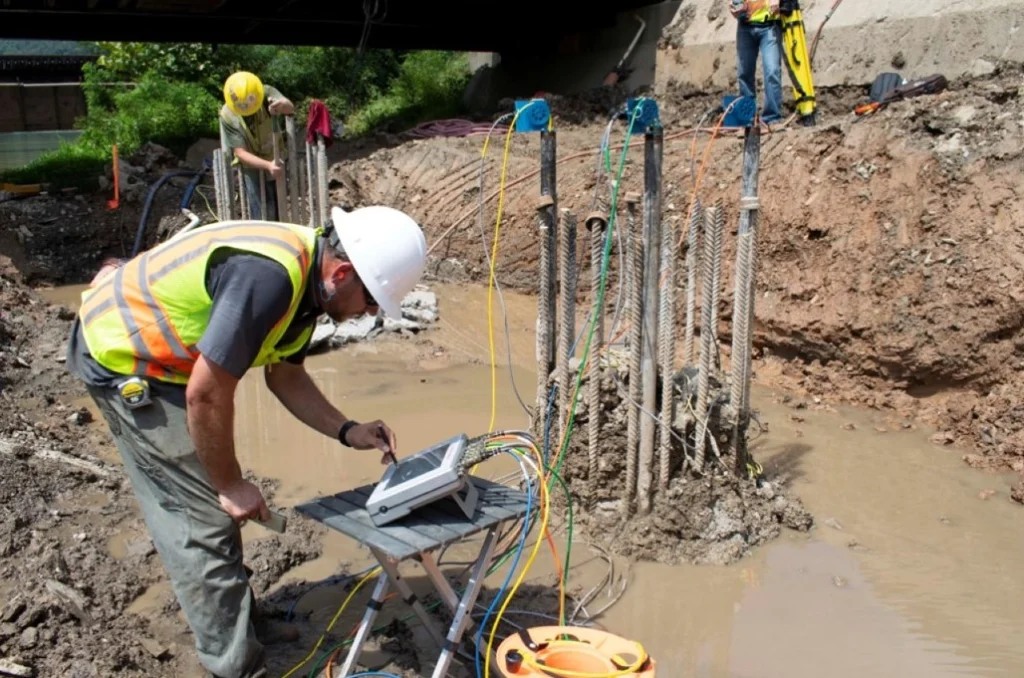
Pile defects can be difficult to inspect after concrete placement. Suitable ultrasonic procedures may support pile quality assessment where access, design, and project specifications allow. Test findings can help engineers identify possible anomalies that deserve closer review.
Structural Steel and Metal Parts
Ultrasonic methods can assess applicable steel plates, sections, components, and welds. Sound-wave responses may show internal discontinuities that ordinary surface checks could miss.
Existing Buildings
Owners planning repairs, retrofits, renovations, or property assessments may request an Ultrasonic Test before major work begins. Non-destructive testing helps gather condition data while preserving finished or occupied areas where possible.
New Construction Quality Control
Contractors and consultants may include an Ultrasonic Test as part of project quality checks. Testing can support documentation before acceptance, turnover, repair approval, or payment evaluation.
Ultrasonic Test Compared With Destructive Testing
Destructive testing often requires cutting, drilling, coring, breaking, or removing a sample. Such methods can provide valuable direct data, yet they also leave openings or damaged sections that require repair.
An Ultrasonic Test usually causes little or no damage. It allows technicians to assess multiple points across a component while keeping most surfaces intact. This approach can reduce restoration work and limit disruption at active project sites.
Speed also matters. Accessible areas can often be checked without heavy demolition. Teams may gather data from several locations during a planned site visit. Results can then guide any focused destructive test that may still be needed.
Ultrasonic and destructive methods should not always be treated as competing choices. Some projects gain better results when both methods are used. An Ultrasonic Test may locate suspect areas, while core testing or laboratory checks may confirm material properties at selected points.
When Should a Project Request an Ultrasonic Test?
Project teams may request an Ultrasonic Test after visible cracking, questionable concrete placement, impact damage, fire exposure, vibration, water entry, or unusual structural movement. Testing may also be useful before repair, retrofitting, renovation, acceptance, or turnover.
Older buildings may need an Ultrasonic Test when records are incomplete or when owners plan major changes. New projects may require testing after a failed inspection or when concrete quality appears inconsistent. Engineers may also request testing to compare several structural zones.
Timing can affect cost and repair options. Testing completed before finishes, equipment, or occupancy restrict access may be easier to carry out. Early checks also allow teams to respond before a small defect becomes a larger concern.
Step-by-Step Ultrasonic Test Procedure
Project Review
The laboratory reviews drawings, specifications, material type, suspected concerns, and client objectives. Clear goals help the testing team choose suitable equipment and test coverage.
Site Assessment
Technicians check access, surface condition, thickness, shape, nearby obstructions, safety rules, and environmental conditions. These details may affect probe placement and reading quality.
Equipment Calibration
Testing equipment must be checked against suitable reference standards or calibration blocks. Proper calibration helps support consistent readings and traceable results.
Surface Preparation
Loose material, dirt, heavy coatings, or rough patches may need removal. A suitable couplant may be applied so sound energy can pass between the probe and surface.
Data Collection
The technician places the probe at planned locations and records each response. Readings may be repeated or compared from different directions when a result appears unusual.
Technical Review
Collected data is studied alongside drawings, visual observations, calibration details, and material information. Suspect zones are marked for discussion or added testing.
Report Preparation
The final Ultrasonic Test report may include project details, test locations, method, equipment, observations, recorded data, interpretation, limitations, and recommendations. Report scope depends on client needs and applicable requirements.
Factors That Affect Ultrasonic Test Results
Several conditions may influence sound-wave behavior. Concrete moisture, aggregate type, reinforcement, surface roughness, temperature, density, cracks, thickness, and geometry may change readings. Metal grain structure, weld profile, probe angle, and surface finish can also matter.
Operator skill plays a major role. Probe placement, calibration, coupling, point spacing, and data interpretation require technical knowledge. Poor technique may create misleading results or miss areas of concern.
Access can also limit coverage. A component may have only one available surface, restricted probe positions, heavy finishes, or nearby equipment. Project teams should provide clear site details so the laboratory can plan realistic test coverage.
How to Read Ultrasonic Test Results
An Ultrasonic Test report should be read as part of a broader engineering review. The report may identify normal patterns, unusual responses, suspected discontinuities, or areas that need added checks. It should also state relevant limitations.
A signal anomaly does not always equal a confirmed structural defect. Reinforcement, geometry, moisture, interfaces, or surface condition may create a similar response. Technicians compare multiple readings to reduce false conclusions.
Structural safety decisions should be made by a qualified engineer who can review Ultrasonic Test findings together with design loads, drawings, site history, visible damage, material records, and other test data. The test provides valuable evidence, but no single method can answer every structural question.
Benefits of an Ultrasonic Test for Project Teams
An Ultrasonic Test offers practical value across project stages. It can locate hidden concerns, reduce needless demolition, support focused repairs, and create technical records for quality control.
Contractors may use test findings to verify workmanship or respond to consultant concerns. Developers may gain better information before accepting completed work. Engineers may use results to choose repair locations or recommend added investigation. Owners may reduce uncertainty before renovation or continued use.
Because an Ultrasonic Test can cover several points without major surface damage, it is often suitable for completed structures and active sites. Proper planning helps reduce disruption while producing useful condition data.
Why Laboratory Accreditation Matters
Construction testing affects safety, cost, compliance, and project acceptance. A qualified laboratory should have suitable equipment, documented procedures, trained personnel, calibration records, and clear reporting practices.
DPWH-BRS accreditation shows that a laboratory has met applicable requirements set by the Department of Public Works and Highways–Bureau of Research and Standards. Project teams should still confirm that the requested Ultrasonic Test falls under the laboratory’s current scope and matches the project specification.
ASTM and AASHTO procedures provide recognized technical guidance for many material tests. The correct standard depends on the material, purpose, equipment, and contractual requirement. Clients should share all specifications before site work begins.
Why Choose Inch-On Materials Testing Laboratory?
Inch-On Materials Testing Laboratory has served engineering and construction projects since November 2018. The company operates as an independent testing laboratory focused on soil, concrete, construction materials, and foundation piles.
Its DPWH-BRS accreditation supports project requirements that call for a recognized Philippine testing provider. Inch-On also follows applicable ASTM and AASHTO methods, helping clients receive reports based on established technical procedures.
The laboratory provides both site-based and laboratory services using specialized equipment. For an Ultrasonic Test, this capability helps the team prepare for actual project conditions, access limits, material type, and reporting needs.
Clear documentation also supports better project decisions. Inch-On prepares technical results for contractors, developers, engineers, consultants, and owners who need reliable information about material condition and possible internal defects.
What Clients Should Prepare Before an Ultrasonic Test
Clients can help the laboratory plan better by sharing the project location, drawings, material type, component dimensions, suspected defect areas, required standard, report deadline, and site contact details.
Photos of the test area may help confirm access and surface condition. Clients should also mention coatings, finishes, nearby equipment, work-height requirements, restricted hours, safety permits, and any previous test results.
Clear objectives are equally important. A request to “check the structure” may be too broad. A better request may ask the laboratory to assess a cracked beam, compare concrete zones, examine a weld, or check specific pile locations.
Choosing an Ultrasonic Test Provider
Choose a provider based on accreditation, technical capability, relevant experience, equipment condition, reporting quality, and knowledge of applicable standards. Ask whether the team has handled similar materials and project conditions.
The cheapest quotation may not offer enough test points, suitable equipment, proper calibration, or useful reporting. Compare scope rather than price alone. Confirm what the report will contain and whether the provider will explain limitations.
A good Ultrasonic Test provider should ask questions before testing. Project purpose, material type, thickness, access, suspected defect, and required standard all affect the selected method.
Frequently Asked Questions About Ultrasonic Test
What Is an Ultrasonic Test Used For?
An Ultrasonic Test is used to assess internal material condition and locate possible cracks, voids, honeycombing, inclusions, or other discontinuities. It supports quality control, repair planning, condition assessment, and project documentation.
Does an Ultrasonic Test Damage Concrete or Steel?
An Ultrasonic Test is generally non-destructive. Most procedures do not require cutting, coring, or breaking the tested component. Minor surface preparation may be needed for proper probe contact.
Can an Ultrasonic Test Detect Cracks?
Yes, suitable ultrasonic methods may detect or help locate internal cracks. Detection depends on crack size, direction, depth, material, probe position, and test access.
Can an Ultrasonic Test Find Concrete Voids or Honeycombing?
An Ultrasonic Test may show unusual signal behavior caused by voids, air pockets, poor compaction, or honeycombing. Further tests may be recommended when results need confirmation.
Can an Ultrasonic Test Be Used on an Existing Building?
Yes. Testing may be completed on accessible beams, columns, slabs, walls, steel parts, and other applicable components. Site condition and surface access affect the final scope.
How Long Does an Ultrasonic Test Take?
Testing time depends on the number of points, component size, access, surface condition, material, site rules, and reporting needs. A laboratory can give a clearer schedule after reviewing project details.
Does an Ultrasonic Test Prove That a Structure Is Safe?
No single test can prove total structural safety. An Ultrasonic Test provides technical data about tested areas. A qualified engineer should review those findings together with drawings, loads, damage history, and other evidence.
Are Results Available Right Away?
Field readings are collected during testing, but proper review and report preparation require technical analysis. Reporting time depends on data volume, project complexity, and client requirements.
What Standards Apply to an Ultrasonic Test?
Applicable standards depend on the material, test purpose, selected method, and project specification. Inch-On Materials Testing Laboratory follows relevant ASTM and AASHTO procedures where required.
Why Choose Inch-On Materials Testing Laboratory for an Ultrasonic Test?
Inch-On offers DPWH-BRS accredited engineering and construction testing, specialized equipment, site and laboratory capability, and experience with soil, concrete, construction materials, and foundation piles. Its technical reports help project teams make better-informed quality and repair decisions.